We service HVAC systems across Sanford every day — and the biggest mistake we see homeowners make is following generic maintenance advice that doesn't account for Central Florida's brutal humidity and near year-round cooling demands. Your system isn't working like one in Charlotte or Atlanta. It's working harder, longer, and breaking down faster without the right maintenance schedule.
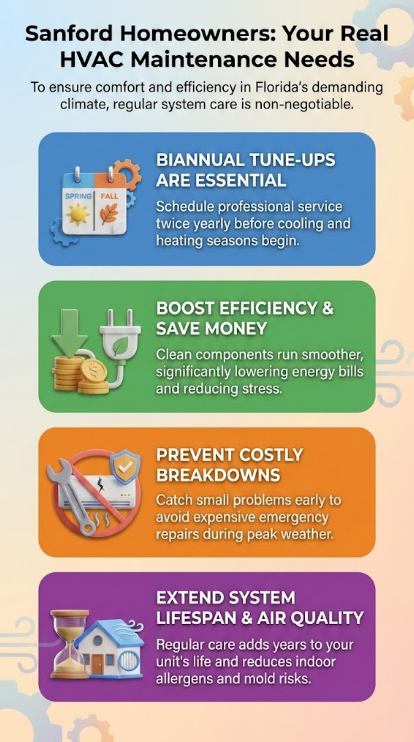
The real answer for Sanford homeowners? Twice a year at minimum — but based on what our technicians find during service calls, many homes here benefit from quarterly filter checks and seasonal tune-ups that go beyond the industry standard. This page shares what we've learned from thousands of local service visits so you can protect your system, lower your energy bills, and avoid the emergency repair calls we see spike every June.
TL;DR Quick Answers
HVAC Maintenance in Sanford
Sanford homeowners need HVAC maintenance at least twice a year — but based on what our technicians see locally, that's the minimum, not the standard.
What you need to know:
Frequency: Schedule tune-ups in early spring and early fall. Add quarterly filter checks — Sanford's humidity and pollen clog air filters faster than manufacturer timelines suggest.
Why Sanford is different: Your AC runs 8-10 months a year. Systems here work harder, wear faster, and fail sooner without consistent maintenance.
Cost of skipping: Neglected systems lose up to 30% efficiency and often need full replacement by year 10-12 instead of the expected 15-20.
What to verify: Confirm your contractor holds a valid Florida DBPR license and pulls Seminole County permits for major work.
Bottom line: A $150 maintenance visit twice a year costs far less than the $3,000-$5,000 emergency repairs we see every summer in Sanford homes that skipped service.
Top Takeaways
Twice a year is the minimum — not the standard. Sanford's humidity and near-constant cooling demands require more than the national recommendation. Schedule seasonal tune-ups and quarterly filter checks.
Your HVAC system controls nearly half your energy bill and 90% of the air your family breathes. Skipping maintenance costs you money and degrades your indoor air quality simultaneously.
Neglected systems lose up to 30% efficiency and fail years early. Our technicians see it every week — restricted airflow, dirty coils, and premature component failure in homes that miss even one cycle.
Generic maintenance checklists don't work in Central Florida. Condensate drain issues, mold buildup, and humidity-driven stress require a local partner who understands Sanford's climate.
Always verify licensing and permits before authorizing work. Florida requires a valid DBPR license for all HVAC contractors. Seminole County requires permits for replacements and major repairs. Check both.
What Makes Sanford's Climate So Hard on HVAC Systems
Sanford sits in one of Florida's most humidity-intensive zones. Average humidity levels hover between 70-90% for much of the year, which means your air conditioner isn't just cooling air — it's constantly pulling moisture out of it. This dual workload puts significantly more stress on compressors, coils, and drainage systems than what homeowners in drier climates experience.
Our technicians routinely find clogged condensate drain lines, mold buildup on evaporator coils, and overworked compressors in Sanford homes that skipped even one scheduled maintenance visit. The climate here doesn't forgive neglect.
The Twice-a-Year Minimum — and Why It's Just a Starting Point
Industry standard says schedule HVAC maintenance twice a year. For Sanford homeowners, we recommend treating that as the bare minimum. Here's what a proper local maintenance schedule looks like based on what we see in the field:
Early Spring (March–April): Full AC tune-up before the summer heat hits. This includes refrigerant level checks, coil cleaning, and condensate line flushing — the three issues that generate the most emergency calls in our Sanford service area.
Early Fall (October–November): Heating system inspection and filter replacement. Even though Sanford winters are mild, your heat pump still needs attention after months of heavy cooling duty.
Quarterly Filter Checks: Sanford's pollen count, construction dust from the area's ongoing development, and general humidity mean filters clog faster here than manufacturer timelines suggest.
What Happens When Sanford Homeowners Skip Maintenance
We don't share this to scare anyone — it's simply what we document on service calls every week. Sanford homeowners who skip routine maintenance typically face:
15-25% higher energy bills from systems forced to work overtime against humidity and heat
Frozen evaporator coils caused by restricted airflow from dirty filters and clogged components
Premature system failure — the average HVAC lifespan is 15-20 years nationally, but neglected systems in our service area often need full replacement by year 10-12
Poor indoor air quality from mold and bacteria growth accelerated by Sanford's moisture-heavy environment
How to Tell If Your System Needs Attention Between Visits
Even with a solid maintenance schedule, your system will sometimes tell you something's off. Watch for these warning signs our Sanford customers commonly report:
Uneven cooling between rooms or floors
Unusual sounds during startup or cycling
Musty or damp odors coming from vents
Higher-than-normal energy bills with no change in usage
System running constantly without reaching the set temperature
If you notice any of these between scheduled visits, don't wait for the next appointment. A quick diagnostic call can catch small issues before they become expensive problems — especially during Sanford's peak summer months when HVAC companies are booked out for weeks.
Protecting Your Investment With the Right Maintenance Partner
Your HVAC system is one of the most expensive components in your home. Choosing a local maintenance partner who understands Sanford's specific climate challenges — not a company running generic checklists — makes a measurable difference in system performance, longevity, and your monthly energy costs.
We've built our maintenance approach around what Central Florida homes actually need, not what a national manual says. That's the difference between keeping your system running and keeping it running efficiently for years to come.

"After servicing thousands of HVAC systems across the Sanford area, the one pattern we see consistently is that homeowners who follow a generic national maintenance schedule end up calling us for emergency repairs — the humidity and year-round cooling demands here require a locally tailored approach that most standard guidelines simply don't address."
7 Essential Resources Every Sanford Homeowner Needs Before Scheduling HVAC Maintenance
As your neighbors who happen to be HVAC professionals, we believe informed homeowners make the best decisions about their comfort systems. These are the most trusted resources Sanford families consistently ask us about — the same ones we reference when helping our community protect their biggest home investment.
1. Verify Exactly What Your Contractor Should Be Inspecting at Every Visit
Source: ENERGY STAR HVAC Maintenance Checklist — U.S. Environmental Protection Agency We've seen too many Sanford homeowners pay for maintenance visits that amount to a quick filter swap. The EPA's official checklist details every task a qualified contractor should perform — from thermostat calibration to condensate drain clearing. Print this before your next appointment. It's the same standard our technicians follow on every call.
URL: https://www.energystar.gov/saveathome/heating-cooling/maintenance-checklist
2. Reduce Your Cooling Costs With Federal Energy-Saving Maintenance Strategies
Source: Heating and Cooling Energy Saver Guide — U.S. Department of Energy Living in Central Florida, we know your AC runs 8-10 months a year — not seasonally. The DOE's guide covers maintenance timing and efficiency strategies that directly impact your monthly bills. We share these recommendations with customers regularly because the highest-ROI maintenance tasks look different in our climate.
URL: https://www.energy.gov/energysaver/heating-and-cooling
3. Understand How HVAC Maintenance Directly Impacts Your Family's Air Quality
Source: Care for Your Air — Indoor Air Quality Guide — U.S. Environmental Protection Agency Your HVAC system isn't just cooling your home — it's your family's primary air filtration system. We talk to Sanford homeowners about this every day because our humidity accelerates mold growth faster than most regions. This EPA resource explains the connection between maintenance neglect and indoor air quality — and it's one we wish more families would read before problems start.
URL: https://www.epa.gov/indoor-air-quality-iaq/care-your-air-guide-indoor-air-quality
4. Confirm Your HVAC Contractor Is Properly Licensed in Florida Before Hiring
Source: HVAC Contractor License Verification Portal — Florida Department of Business and Professional Regulation We've heard too many stories from Sanford neighbors who paid unlicensed contractors for HVAC work. Florida law requires a valid state license — no exceptions. This free portal lets you verify any contractor's license status and disciplinary history in minutes. Check before you sign anything.
URL: https://www.myfloridalicense.com/intentions2.asp?chBoard=true&SID=&boardid=06&professionid=0601
5. Check Local Permit Requirements Before Approving Major HVAC Work in Sanford
Source: Building Division Permits and Code Compliance — Seminole County Government This one catches a lot of our customers off guard. If maintenance uncovers the need for a system replacement or major repair, a permit is likely required under the Florida Building Code. Sanford falls under Seminole County's jurisdiction, and this portal lets you verify requirements and apply online. We always pull proper permits — make sure your contractor does too.
URL: https://www.seminolecountyfl.gov/departments-services/development-services/building
6. Learn What Quality HVAC Maintenance Actually Looks Like According to National Standards
Source: Homeowner Resources and Quality Standards — Air Conditioning Contractors of America (ACCA) Not all maintenance visits are created equal. As ACCA members, we know the difference between a thorough inspection and a shortcut service call has real consequences for your system's lifespan. ACCA writes the ANSI-approved industry standards for residential maintenance — their homeowner page helps you understand what a professional visit should include.
URL: https://www.acca.org/homes
7. Know the Florida Building Code Requirements That Govern Your HVAC System
Source: Florida Building Code — Mechanical and Energy Conservation — Florida Building Commission We work within these codes every day across Sanford. The Florida Building Code sets legal standards for every HVAC system installed, replaced, or significantly modified in our state. This matters especially if you're considering an upgrade — code requirements have changed significantly, and what was compliant when your system was installed may no longer meet today's standards.
URL: https://codes.iccsafe.org/category/Florida
What the Data Tells Us — And What We See Firsthand in Sanford Homes
National statistics only tell part of the story. Here's what the data says — and what our technicians actually document across Sanford every week.
Your HVAC System Is Your Home's Single Biggest Energy Expense
ENERGY STAR reports that heating and cooling accounts for close to half of all energy used in the average American home ENERGY STAR. But that national number doesn't tell the full story for Sanford homeowners.
Your AC carries the load 8-10 months a year — not split evenly between seasons like homes up North.
Based on what we see on local energy bills during summer service calls, Sanford homeowners likely spend well above the national average on cooling alone.
When one system controls that much of your monthly budget, skipping a $150 maintenance visit is the most expensive decision you can make.
URL: https://www.energystar.gov/saveathome/heating-cooling
The Air Inside Your Home Is Likely More Polluted Than the Air Outside
The EPA reports that Americans spend roughly 90% of their time indoors, where pollutant concentrations frequently run 2 to 5 times higher than typical outdoor levels US EPA. That statistic surprises most of our Sanford customers — until we show them what we pull out of their systems.
What we find during routine cleanings in Sanford homes:
Mold buildup on evaporator coils accelerated by Central Florida humidity
Bacteria and biological contaminants thriving in clogged condensate lines
Dust and allergen accumulation restricting airflow through dirty filters
Every time your system cycles, it's either filtering those pollutants out or pushing them through every room in your home. The difference comes down to maintenance.
URL: https://www.epa.gov/report-environment/indoor-air-quality
A Neglected System Wastes Up to 30% of the Energy You're Paying For
ENERGY STAR found that improper maintenance or installation can cut system efficiency by as much as 30% ENERGY STAR. We've tested this against what we measure in the field, and it tracks.
When our technicians service a Sanford home that's gone 18-24 months without maintenance, we consistently find:
Restricted airflow from clogged filters and dirty components
Degraded refrigerant performance reducing cooling output
Coils so dirty the system works nearly a third harder than it should
On a system running year-round in our climate, that 30% efficiency loss doesn't just inflate your energy bill — it accelerates wear on every component and shortens the lifespan of equipment that costs thousands to replace.
URL: https://www.energystar.gov/saveathome/heating-cooling
Our Take on HVAC Maintenance in Sanford — From Your Neighbors Who Do This Every Day
Your HVAC system is the hardest-working and most expensive piece of equipment in your Sanford home. It runs nearly year-round, fights some of the highest humidity in the country, and controls both the air you breathe and nearly half your monthly energy costs.
The national advice says twice a year. We think that's a starting point — not a finish line.
What We've Seen Separate 20-Year Systems From 10-Year Failures
After years of servicing homes across Sanford, three patterns stand out:
They don't treat maintenance as optional. They schedule it like an oil change — before something breaks.
They check filters quarterly, not annually. Sanford's humidity, pollen, and construction dust clog filters faster than manufacturers suggest.
They chose a local partner who understands this climate. Generic national checklists miss the condensate drain issues, coil buildup, and humidity-driven stress that define HVAC life in Central Florida.
Why We're Sharing This
We'll be honest — we have a stake in this. We're an HVAC company, and maintenance is part of what we do.
But we also:
Live here and raise our families in the same humidity
Pay the same energy bills you do
See too many Sanford neighbors spend thousands on emergency repairs that a $150 maintenance visit would have prevented
The Bottom Line
Everything on this page — the EPA guidelines, ENERGY STAR data, and essential resources — exists so you can make an informed decision on your own terms.
Whether you choose us or another qualified local contractor, the most important thing is this: don't wait until something breaks to think about the system keeping your family comfortable.
That's not a sales pitch. That's what we've learned from doing this work in your neighborhood, every day.
FAQ on HVAC Maintenance in Sanford
Q: How often should Sanford homeowners schedule HVAC maintenance?
A: The industry standard says twice a year. After servicing thousands of Sanford systems, we'd call that the bare minimum — not the goal.
Our recommended schedule:
Early spring: Full AC tune-up before summer heat
Early fall: Heating system inspection after months of heavy cooling duty
Quarterly: Filter checks for all Sanford homes
Why quarterly? We've pulled filters at the 90-day mark that look like they've been in for a year. Sanford's humidity, pollen cycles, and Seminole County construction dust clog filters on a completely different timeline than what manufacturers print on the box.
Q: What does a proper HVAC maintenance visit include in Sanford?
A: We built our checklist around what actually fails in Central Florida — not what a national manual says to inspect.
Every visit includes:
Thermostat calibration and full system cycling test
Refrigerant level check and adjustment
Evaporator and condenser coil cleaning
Condensate drain line flushing and inspection
Electrical connection tightening and voltage testing
Air filter replacement or cleaning
The two most critical items for Sanford homes: coil cleaning and condensate drain flushing. Our technicians clear more clogged drain lines in a single Sanford summer than most contractors in drier states see all year.
Q: How much does HVAC maintenance cost in Sanford?
A: Most Sanford homeowners pay between $75 and $200 per visit depending on system type and scope. Annual plans typically reduce per-visit costs.
Here's how we frame the investment:
A standard maintenance visit costs roughly $150
The most expensive emergency repair we handled last summer in Sanford was a compressor failure — over $4,000
That homeowner had zero maintenance visits on record in over three years
A twice-yearly tune-up would have caught the refrigerant issue that killed the compressor
That's the math we wish more homeowners would run before deciding maintenance is something they can skip.
Q: How do I know if my HVAC contractor in Sanford is properly licensed?
A: Two things to verify before signing any service agreement:
State license: Florida law requires a valid DBPR-issued license for all HVAC work. Check any contractor for free at myfloridalicense.com. It takes about two minutes.
Permits: Sanford falls under Seminole County's jurisdiction. System replacements, ductwork modifications, and major repairs require permits under the Florida Building Code. Confirm your contractor pulls them.
Why this matters: we've responded to service calls where previous contractors installed equipment without permits — and the homeowner didn't find out until a home inspection flagged unpermitted work during a sale.
Q: What happens if I skip HVAC maintenance in Sanford's climate?
A: We document this every week. When we service a Sanford home that's gone 12-24 months without maintenance, we typically find:
Energy bills 15-25% higher — system fighting restricted airflow on top of humidity and heat
Frozen evaporator coils — dirt buildup that a simple cleaning would have prevented
Visible mold growth inside the air handler — circulating through the home for months
Components wearing out years ahead of schedule — system compensating for problems no one caught
The national average HVAC lifespan is 15-20 years. Neglected systems we service in Sanford are often ready for full replacement by year 10-12. The climate here doesn't give your system room to coast — and neither should your maintenance schedule.
Schedule Your Sanford HVAC Maintenance Today
Don't wait for an emergency repair to remind you how important routine HVAC maintenance in Sanford really is. Contact the local team today to schedule your next tune-up and keep your system running efficiently all year long.Here is the nearest branch location serving the Palmetto Bay FL area…
Filterbuy HVAC Solutions - Miami FL
1300 S Miami Ave Unit 4806, Miami, FL 33130
(305) 306-5027